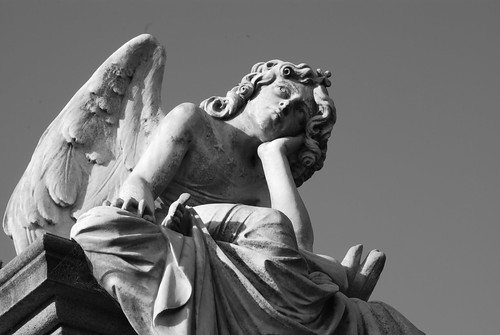
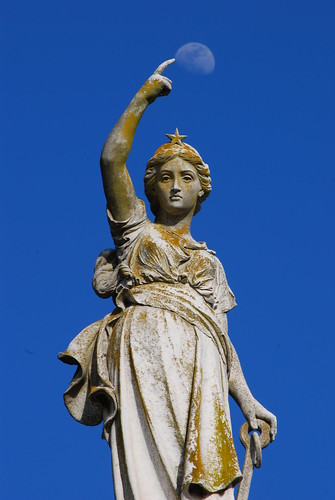
Where Angels Dwell

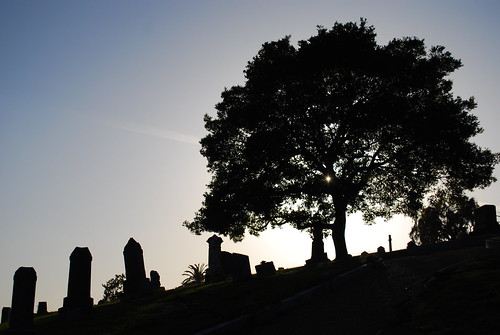
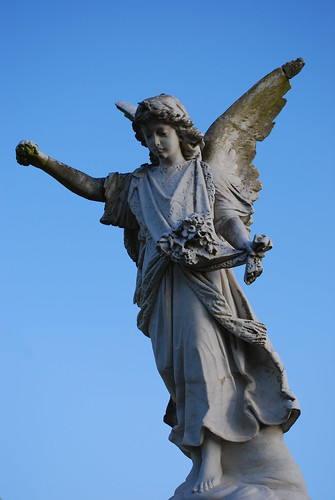
I was passing by Mountain View Cemetery a bit before dusk today, so I decided to go in and take some pictures.
DSC_0099

DSC_0084

DSC_0051

DSC_0034

I posted a few more in a Flickr set.

10 Responses to “Where Angels Dwell”

  1. ng says:

    wonderful! If not for the first one, I’d think it was a museum, with the clear backgrounds, except of course for the moon that the last woman is pointing to.

  2. ng says:

    In these and in the Flickr set, what accounts for the difference between the colored ones and the black and white ones?

  3. dc says:

    I was playing around with the settings a fair amount, still trying to figure out what apertures and shutter speeds work best for certain things, etc. I decided to take some shots in black and white too, just to see how they came out—it seemed fitting for the tombstones and statues.

    Unfortunately, a small piece of dog hair (or something) was stuck on the lens; you can see evidence of it just above the angel’s wing in the black and white photo, and to the left of the statue’s hip in the bottom photo. There’s another piece of dust causing problems above the black and white angel’s right ear and left of the bottom statue’s armpit, but it’s less visible than the hair. I assume there are ways to clean up those sorts of blemishes after the fact, if I cared to. (I cleaned up the lens before I took the other two shots, so the hair and dust speck don’t appear in those.)

  4. jabel says:

    I used to love wandering around Mountain View the near year I lived in Berkeley but didn’t realise it was an Olmsted design until I read the Bio on him.It’s a bit more open but it reminds me a lot of Mt. Hope in Rochester N.Y. with it’s rolling hills and huge old trees.Mt. Hope is really beautiful in fall awash with color something an Oakland fall can’t provide.I think Frank Norriss(sp) the author is buried in Mountain View but I wandered around there in 1975 before I knew who he was.

  5. dc says:

    I’ve been lucky enough to have always lived within a couple of miles—and often a couple of blocks, in the cases of Franklin Park, Prospect Park, Riverside Park, etc.—of an Olmsted design, no matter which city on which coast I’ve lived in. I just glanced at his Wikipedia entry, and it’s amazing how many parks around the country he gets credit for. Is the Witold Rybczynski bio the one you read? I have that book here, but I’ve never read it. Did Olmsted really design everything he designed, or did he turn himself into a kind of brand or factory, with proteges doing all the work? If the latter, then maybe they should attribute the designs to “School of Olmsted” the way they do with Rembrandt et al…

  6. jabel says:

    Yes it’s the Rybcznski and Olmsted did have help as the buisness grew.He did some things in Buffalo also .Olmsted did several of the city parks in Rochester but MT.Hope cemetery was before his time I beleive.I thought it odd the Wikipedia article? mentioned Yosemite.I don’t know how Olmsted designed Yosemite.

  7. dc says:

    I’m pretty sure he designed Everest and the Grand Canyon too. I’m not sure about the moon—that might have been Calvert Vaux’s idea.

  8. unique distance from isolation says:

    I love the way she’s pointing to the moon in the last one–kind of a reversal of the classic pose where the VIrgin Mary is standing on the moon, as in paintings by Murillo and Velazquez and so on, and wearing a crown of stars–I think the image comes from somewhere in the bible. Your shot makes the woman seem in command of the moon somehow–a very different feel. And I love how in the first one the tree dominates the sun…

    Another thought: why is it that I often like photos of sculptures more than I like the sculptures themselves? I’m afraid it says something about my lack of sophistication—needing my images pre-digested, or as if I can only handle 2 dimensions at a time.

  9. Carol says:

    Unique, I’d say that at some level the distancing from the sculpture created by the photograph adds a certain irony to which an intelligent person such as yourself would enjoy responding. As for the statuary itself, one must know something about statue making to properly appreciate, and if AIPSAY doesn’t have that requisite knowledge the statue experience is uncomfortable.

    But I could be wrong.

  10. unique distance from isolation says:

    Irony? That’s interesting, because I am having trouble imagining what it could mean. Looking at a photo of a sculpture doesn’t FEEL more distanced to me–it actually feels more immediate–but maybe that’s because the actual 3-D object always seems somehow more than I can take in. Maybe that’s the second part of what you said, although I’m reluctant to think that the observer would have to know something about statue-making, since that would make statuary the only art I can think of that would require such knowledge. Of the making of most of the the arts I most enjoy–paintings, music, movies, dance–I know nearly nothing! On the other hand, I have spent way, way more time looking or listening to those arts than looking at sculpture. So maybe I just need more looking time.

Leave a Reply